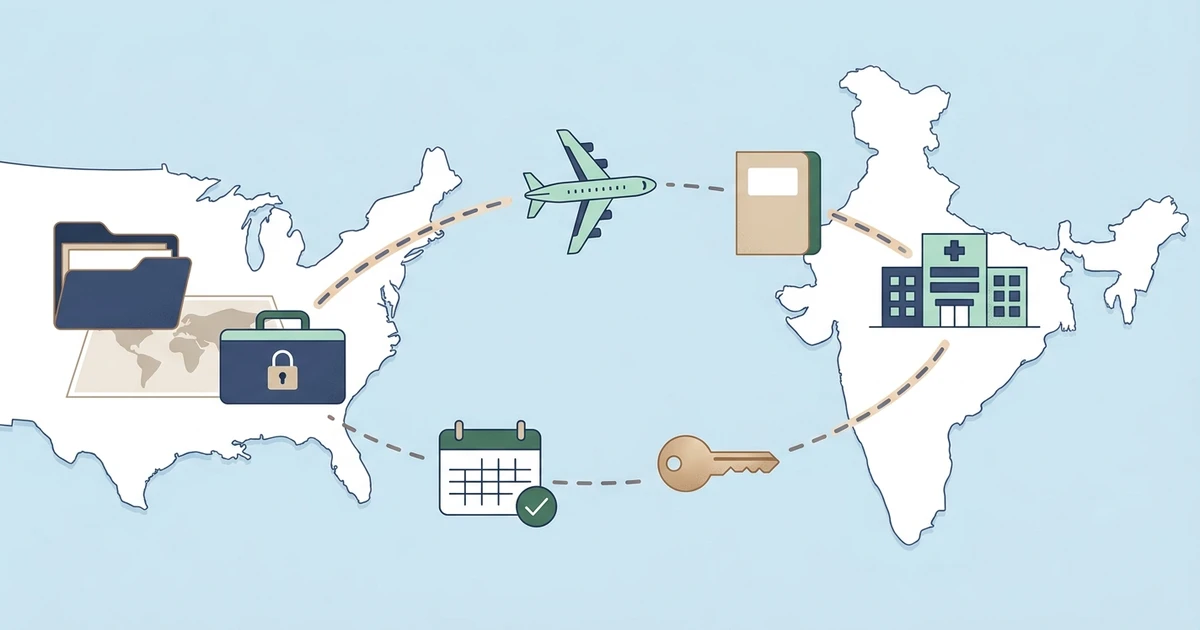
Quick answer: what must a USA-to-India medical travel plan confirm?
A USA-to-India medical trip should not begin with flights. Confirm that the U.S. treating clinician understands the plan, the Indian specialist has reviewed the relevant records, the hospital estimate is written and itemized, the current visa route is verified, insurance questions are answered in writing, and return follow-up is planned before any non-refundable booking.
| Decision | What to confirm before booking | Owner |
|---|---|---|
| Clinical timing | Whether international review or treatment could delay urgent U.S. care | U.S. treating clinician and Indian specialist |
| Records | Which reports, images, pathology material, medicines, and summaries were reviewed | Proposed Indian clinical team |
| Hospital estimate | Procedure assumptions, inclusions, exclusions, room, stay, currency, deposit, refund terms | Exact Indian hospital branch |
| Visa and advisory | Current Indian medical visa or medical attendant route, and U.S. travel advisory context | Official Government of India and U.S. sources |
| Insurance and payment | Planned-care coverage, complication coverage, preauthorization, reimbursement, direct-pay rules | U.S. insurer and hospital finance team |
| Return care | Discharge records, medicines, rehabilitation, fit-to-fly decision, and U.S. clinician handoff | Indian treating team and U.S. clinician |
Helpful next pages:
| If you are deciding… | Use this Virello page |
|---|---|
| Whether India is practical | Medical tourism in India checklist |
| How to model the total budget | Medical treatment budget in India |
| Which city may fit the case | How to choose an Indian medical city |
Coordinate with the U.S. clinician first
The CDC medical-tourism guidance recommends a pre-travel consultation, English-language records, a complication plan, insurance review, and continuity after return. Tell the current clinician what opinion or treatment is being considered and ask whether seeking it internationally could affect time-sensitive local care.
- Clarify the working diagnosis and unresolved question.
- Ask which records and images should be transferred.
- List current medicines using generic names where possible.
- Identify care that must continue before travel.
- Agree on who will receive Indian records and manage follow-up.
If there may be an emergency or worsening condition, contact local emergency services or a licensed clinician. Do not postpone urgent evaluation to arrange international travel.
Prepare the record set
Use the receiving team’s instructions rather than a universal upload list. Transfer records only through an approved secure route, such as Virello Health’s report-intake page, not through this repository or chat.
- Clinician summary and relevant history.
- Pathology, laboratory, imaging, and procedure reports requested by the specialist.
- Imaging files in the requested format.
- Discharge and operative notes where relevant.
- Current medicines, allergies, and important prior treatments.
- U.S. clinician contact details shared with consent.
- Questions for the Indian specialist.
Confirm whether the remote opinion is preliminary and what examination or testing in India could change it.
Verify passport, visa, and advisory information
India’s official e-Visa portal lists medical and medical-attendant categories and a hospital-letter requirement. The page currently contains conflicting wording about validity and entry count, so use the live portal and issued authorization rather than a fixed duration in a blog.
- Check nationality-specific eligibility and passport rules.
- Use the category that matches the actual purpose.
- Confirm current document and hospital-letter requirements.
- Check attendant rules separately.
- Review the issued authorization before travel.
- Read the current U.S. State Department India advisory, including regional cautions.
Visa assistance is process support. Only the relevant authority decides eligibility and approval, and advisories can change after booking.
Build the financial and insurance plan
Request an itemized hospital estimate after clinical review. Separate it from flights, accommodation, companion expenses, transfers, food, communication, follow-up, and contingency funds. The CDC insurance chapter notes that overseas care may require payment up front and later reimbursement.
- Ask whether planned overseas treatment and its complications are covered.
- Confirm preauthorization and network rules.
- Clarify direct payment versus reimbursement.
- Keep itemized bills, receipts, authorizations, and medical summaries.
- Check pre-existing-condition and evacuation terms.
- Verify hospital bank details independently.
Neither a coordinator nor a blog can promise reimbursement, a final bill, or exchange-rate outcome.
Plan the long-haul journey without self-clearing travel
The return-flight date depends on the procedure, recovery, mobility, complications, airline requirements, and treating-team assessment. A generic timeline cannot establish fitness to fly.
- Ask the U.S. clinician about pre-travel medical considerations.
- Ask the Indian team when it will assess return-travel readiness.
- Check the airline’s medical-information and assistance process.
- Arrange medicines, mobility support, accessible seating, transfers, and a companion as advised.
- Keep essential records and prescribed medicines accessible.
- Use flexible tickets and an extended-stay plan.
Do not start, stop, or change clot-prevention medicine based on travel content. Medication and preventive decisions belong to licensed clinicians.
Prepare the stay and communication
Confirm airport transfer, accommodation near the facility, accessibility, interpreter support, local connectivity, caregiver rest, and a hospital contact route. Ask how admission changes or delayed flights will be handled.
- Exact hospital branch and appointment contact.
- Accessible room and transport needs.
- Companion documents and accommodation.
- Local emergency services and hospital escalation route.
- A backup payment method and verified contacts.
- Copies of travel documents stored separately from clinical files.
Make the handoff home explicit
Before treatment, agree on the records the hospital will provide: discharge summary, procedure or operative report, pathology and imaging results, medicine list, rehabilitation instructions, and follow-up plan. The CDC recommends giving the home clinician a summary of care received abroad.
- Who sends records to the U.S. clinician with consent?
- Who answers post-discharge questions in India?
- Which events does the discharge plan say require urgent assessment?
- Who manages medicines and rehabilitation after return?
- When is the next appointment and which tests are expected?
- Who confirms return-flight clearance?
Virello Health can coordinate documents and appointments but does not provide emergency care or clinical follow-up. You may request case coordination through the approved intake route when the records are ready.
Keep a written decision record
A medical-travel decision is easier to audit when every important answer has an owner, source, and date. Create one record for the USA-to-India care journey. Do not copy an answer from another patient, hospital branch, country, or older quote. If information is missing, label it “not yet confirmed” rather than turning an assumption into a fact.
| Planning item | Confirmation needed before booking | Responsible source |
|---|---|---|
| Clinical reason for travel | What diagnosis or treatment question is the Indian team evaluating, what alternatives remain, and does the U.S. clinician consider the timing appropriate? | The U.S. clinician responsible for current care and the proposed Indian specialist. |
| Record transfer | Which reports, original images, pathology materials, medicine lists, and prior treatment records were received and reviewed? What still requires physical shipment or repeat testing? | The proposed Indian clinical team, using the approved secure transfer route. |
| Passport, visa, and advisory checks | Which current Indian visa process applies, what official documents are required, and what U.S. travel information should be reviewed? | Government of India visa sources, the U.S. Department of State, and other responsible authorities. Do not rely on a promise from a coordinator. |
| Insurance and payment | Does the U.S. plan cover any out-of-country care, preauthorization, emergency care, or follow-up? Which hospital payment methods, deposits, refunds, and exchange fees apply? | The insurer and the hospital’s written finance response. Keep dates, reference numbers, and exclusions. |
| Flight and accessibility | What airport assistance, seating, mobility, medicine-carrying, connection, ground-transfer, and companion arrangements are practical? | The airline for its operational rules; the treating clinician for medical travel advice. Neither substitutes for the other. |
| Hospital and stay contacts | Which branch, appointment, arrival desk, after-hours clinical contact, accommodation address, accessible transport, and extended-stay option are confirmed? | The exact hospital and each service provider within its own scope. |
| Discharge record set | Which procedure or treatment report, test results, images, medicine list, implant or device information, pathology, rehabilitation plan, and contact instructions will be supplied? | The treating hospital. Request the list before admission so missing documents can be resolved before departure. |
| Return and U.S. follow-up | Who decides fitness to travel, what follow-up is due, who will receive the records in the United States, and what happens if the plan changes? | The Indian treating team for discharge and travel advice, and the receiving U.S. clinician for ongoing care. |
Keep one dated contact sheet for these answers. If a proposed treatment, flight, visa instruction, estimate, or return date changes, preserve the earlier version and record who confirmed the replacement. That makes it easier for the U.S. and Indian teams to see which plan is current.
Separate each decision by its owner
Several organizations may participate in the journey, but their authority is not interchangeable.
- The U.S. and Indian treating clinicians assess the medical information, explain reasonable options and risks, obtain informed consent where applicable, plan treatment and follow-up, and decide clinical readiness for travel.
- The hospital confirms the exact facility, appointments, available services, estimate, billing process, records, discharge route, and how unexpected changes are managed.
- The visa, advisory, insurer, and airline authorities each control decisions within their own scopes. A clinician or coordinator cannot promise their approval.
- Virello Health may coordinate records through the approved intake flow, appointments, written-estimate clarification, and non-clinical travel logistics. It is not the treating provider, insurer, visa authority, airline, or emergency service.
- The patient and family decide whether to proceed after receiving appropriate clinical advice and verified logistical information. They may ask for more time or another opinion when the treating team says that doing so will not create harmful delay.
If the U.S. clinician, Indian team, insurer, visa information, airline rule, or hospital schedule conflicts with another part of the plan, return that question to the organization that owns it. Keep dated revisions together so everyone can identify which clinical opinion, estimate, authorization, and itinerary is current.
Reconfirm before payment and travel
Use a final dated check rather than assuming earlier information remains current:
- The U.S. clinician knows what is being considered and has addressed whether international review could affect time-sensitive local care.
- The proposed Indian team received the requested records and identified the limits of its preliminary opinion.
- The exact branch, appointments, current estimate, payment terms, accommodation, ground transport, and hospital contacts are confirmed.
- Current Indian visa information and U.S. travel information were checked through official sources for this trip.
- The insurer answered planned-care, preauthorization, emergency, reimbursement, and follow-up questions in writing where applicable.
- Airline assistance and operational rules are confirmed separately from the treating team’s medical travel advice.
- The Indian hospital and receiving U.S. clinician agree on the required discharge and follow-up record set.
- Return travel remains flexible until the treating clinician provides case-specific clearance.
Save this record outside the blog and update it whenever the clinical plan, estimate, official rule, or travel schedule changes.
How to manage changes after the first plan
Treat the first USA-to-India plan as a dated working document. Medical information, appointment availability, official rules, supplier terms, and the patient’s practical needs can change. Keep a change log rather than replacing the earlier version, because the reason for a change may matter to the clinician, hospital, insurer, authority, or family member reviewing the journey.
For every update, record:
- Whether the change came from a U.S. clinician, Indian team, authority, insurer, airline, hospital, or supplier.
- What changed and who reported it.
- The date and the source document or official page.
- Whether the change affects clinical suitability, timing, cost, travel, accommodation, or follow-up.
- Which decision owner must approve or confirm the next step.
- Whether a revised opinion, estimate, authorization, booking, or consent document is required.
- What remains uncertain and when it will be rechecked.
For USA-to-India planning, a coordinator can organize updates but cannot interpret a changed diagnosis, treatment, medicine, recovery, or travel-readiness decision. Those questions belong with the U.S. or Indian clinician. Revised estimates belong with the hospital; coverage with the insurer; entry with Indian authorities; and operational travel rules with the airline.
Before a non-refundable payment, compare the current U.S. and Indian clinical communications with the hospital estimate, visa information, insurer response, accommodation, and flight plan. Check names, branch, dates, currency, assumptions, and contacts. An Indian hospital invitation does not prove entry approval, and a flight booking does not establish fitness to travel.
Keep a concise cross-border summary listing the U.S. and Indian clinical contacts, current Indian facility and appointment, unresolved questions, insurer and payment references, visa status, flights, accommodation, transport, discharge records, and U.S. follow-up. Store sensitive records in approved systems with consent rather than attaching them to ordinary chat.
If a change creates possible urgency or worsening symptoms, stop the administrative workflow and contact local emergency services or a licensed clinician. The safest logistical plan is always secondary to timely clinical care.
Use a final coordination call effectively
Before the USA-to-India plan is confirmed, send the responsible parties a short agenda rather than reopening every document during the call. List the decisions already confirmed, the items that changed, and the remaining questions in priority order. Ask each person to answer only within their role and identify anything that needs a separate clinician, finance team, insurer, authority, airline, or coordinator response.
After the call, request written confirmation from the correct U.S. or Indian source. Clinical answers come from treating clinicians; estimate changes from the hospital; coverage from the insurer; entry information from official Indian channels; and flight rules from the airline. Update the cross-border summary without treating silence as agreement.
Prepare a departure and return record pack
Keep administrative copies available to the patient and companion without carrying unnecessary sensitive material. The travel pack can contain passport and authorization copies, hospital invitation or appointment information, insurer contacts, airline assistance confirmations, accommodation and transport details, the hospital’s arrival route, payment references, and emergency contacts. Store clinical records only through the approved secure process and according to the receiving team’s instructions.
Prepare the return pack before treatment as well. Ask the Indian hospital which discharge summary, procedure or treatment report, imaging, pathology, medicine information, device or implant record, rehabilitation instructions, and follow-up plan it expects to provide. Ask the U.S. clinician which items must arrive for continued care.
Before departure, reconcile the received documents against both lists. Missing records are easier to resolve while the treating hospital can still access the clinical teams and systems. The pack supports communication; it does not replace the treating clinicians’ discharge, medication, or travel instructions.
Continue planning
- Use the medical tourism in India planning checklist for the complete cross-border workflow.
- Build a case-matched total with the India medical-treatment budget guide.
- Compare access and recovery logistics with the Indian medical-city selection guide.