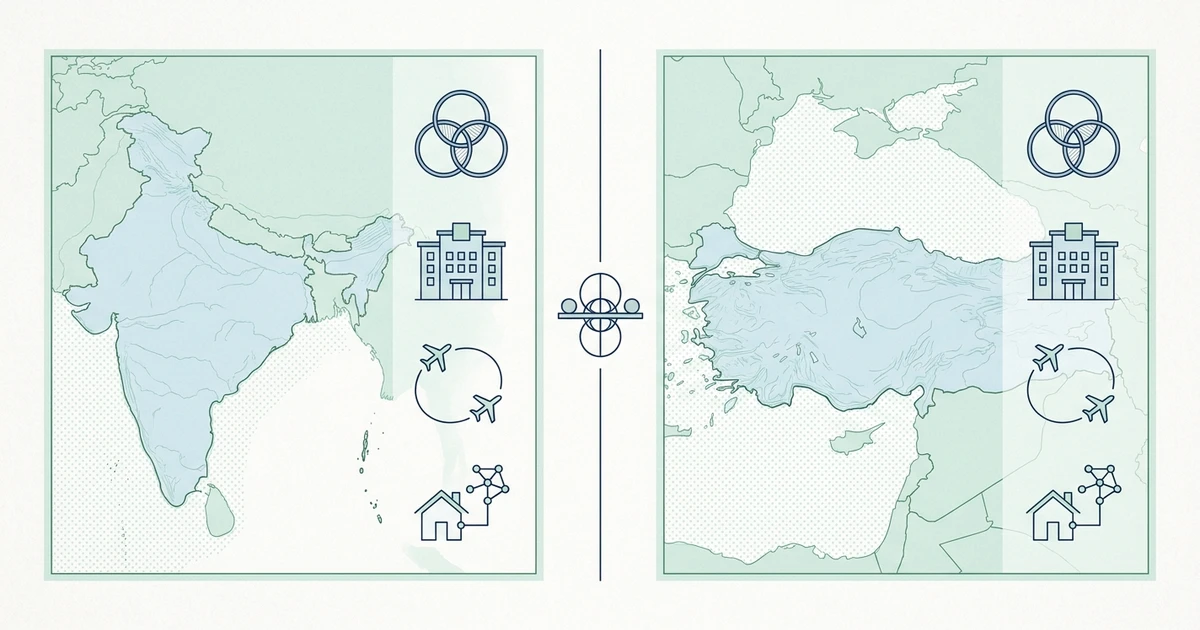
Quick answer: how should patients compare India and Türkiye?
Do not choose India or Türkiye by reputation, a package headline, or a single social-media story. Compare the exact clinical team, facility, estimate, travel route, visa or entry process, complication plan, and home follow-up for the same diagnosis and record set.
For Virello Health, the practical next step is India coordination after report review. Türkiye can still be useful as a comparison destination for pricing, elective procedures, and travel access, but the Turkish provider, facility authorization, estimate, and follow-up must be verified separately.
| Comparison point | India check | Türkiye check | Better decision rule |
|---|---|---|---|
| Clinical fit | Exact Indian specialist, hospital branch, and support services | Exact Turkish specialist, authorized provider, and support services | Compare named teams, not country reputation |
| Cost | Procedure estimate, hospital scope, exclusions, INR or USD basis | Package scope, hospital and hotel split, exclusions, TRY or USD basis | Compare original currencies and identical assumptions |
| Travel burden | Flight route, visa, attendant, city stay, return follow-up | Flight route, entry route, hotel, transfers, return follow-up | Choose the pathway the patient can safely complete |
| Oversight | NABH or facility checks where applicable | Ministry authorization checks where applicable | Record the registry, branch, date, and scope |
| Virello role | India report review, estimate clarification, hospital and travel support | Research comparison only unless service scope changes | Do not treat comparison content as Turkey coordination |
Useful Virello pages for the India side:
| Need | Page |
|---|---|
| Full India planning workflow | Medical tourism in India checklist |
| Budget and estimate comparison | Medical treatment budget in India |
| Country/cost pages | Treatment costs by country |
Use a neutral comparison method
The CDC medical-tourism guidance recommends evaluating the destination, facility, clinician, package scope, complications, insurance, records, and continuity. Apply the same questions to both countries.
- Define the clinical question and urgency.
- Use the same records for each specialist review.
- Compare exact teams and facilities, not countries in the abstract.
- Use case-matched written estimates.
- Plan complications and home follow-up before travel.
If international comparison could delay urgent care, contact a local licensed clinician.
Match the case to a clinical team
Start with the specialty and multidisciplinary expertise the case requires. Ask each option to explain who reviews the records, whether the opinion is preliminary, what alternatives exist, and what support services are relevant.
- Exact branch and department.
- Named clinical roles and verifiable registration.
- Pathology, imaging, intensive care, blood bank, rehabilitation, or other support as relevant.
- After-hours and complication pathway.
- Record transfer and home-clinician communication.
Do not infer that a country is stronger for every condition.
Verify facility status using current registries
For India, search the exact facility in the NABH directory where applicable. For Türkiye, use the Ministry of Health’s authorized healthcare-provider and facilitator lists.
- Match the branch name and address.
- Check current status and scope.
- Verify the clinical department separately.
- Record the verification date.
- Recheck before payment and travel.
Accreditation or authorization is a process and regulatory signal, not a guarantee of clinical fit or result.
Compare complete written estimates
Do not compare national averages or procedure headlines. Ask both hospitals to use the same diagnosis, proposed pathway, room, stay, device, medicine, intensive-care, rehabilitation, and follow-up assumptions.
- Issuer, branch, currency, date, and validity.
- Professional and hospital fees.
- Tests, medicines, devices, and blood products.
- Complication, extended-stay, and readmission terms.
- Deposit, cancellation, refund, and invoice process.
- Travel and facilitator services listed separately.
Only the treating hospital’s current written estimate after review can apply to an individual.
Compare the total trip
A clinically suitable option can still create an impractical journey. Compare current routes and the patient’s actual accessibility and caregiver needs.
- Flight connections and change flexibility.
- Airport-to-hospital transfer.
- Visa or consular process.
- Interpreter and consent-language support.
- Accessible accommodation near the facility.
- Companion and caregiver arrangements.
- Insurance, payment, and contingency funds.
- Follow-up after returning home.
Let the treating team decide fitness to travel and the required time near the hospital.
Check entry rules through official channels
India’s official e-Visa portal lists medical categories but currently contains conflicting duration and entry wording. Türkiye’s foreign-ministry visa guidance states that e-Visas are for specified purposes and that other purposes use diplomatic missions. Nationality and purpose determine the applicable route.
- Check the current official site for the traveller’s passport.
- Confirm the correct purpose and supporting documents.
- Use the issued authorization, not an old blog.
- Do not assume an attendant uses the same process.
- Allow time for official clarification.
A facilitator may support the process; authorities decide eligibility and approval.
Treat regulation as a live check
Türkiye maintains an international health-tourism framework and current authorization lists through its Ministry of Health regulation page. Older English material may remain online while newer Turkish primary rules apply. India and Türkiye also have procedure-specific legal requirements that may be relevant.
- Ask the provider which current rule applies.
- Use primary official material and record the date.
- Seek legal guidance for transplant, fertility, consent, data transfer, or other regulated issues.
- Do not rely on a facilitator’s summary as legal advice.
This article does not compare procedure-specific law or determine eligibility.
Decision matrix
Use the matrix without assigning a default winner.
- Clinical fit and urgency.
- Exact team and facility verification.
- Support for complications and rehabilitation.
- Written estimate and exclusions.
- Route, visa, language, accommodation, and caregiver load.
- Insurance and payment process.
- Discharge records and home follow-up.
- Unresolved regulatory or legal questions.
Choose only after the relevant clinician, provider, insurer, and authority have answered their parts.
Evidence to obtain before choosing
Keep a dated decision file containing the specialist opinion, exact facility details, registry check, written estimate, entry guidance, insurance response, travel plan, complication route, and follow-up agreement.
- No national outcome comparison without equivalent current data.
- No countrywide price claim without comparable case definitions.
- No assumption that authorization proves outcome.
- No unverified partnership or commission claim.
- No booking based on guaranteed treatment, visa, price, or travel clearance.
You may share reports through Virello Health’s approved route for India coordination. Virello does not coordinate treatment in Türkiye and does not decide clinical suitability.
Keep a written decision record
A medical-travel decision is easier to audit when every important answer has an owner, source, and date. Create one record for the India-versus-Türkiye treatment comparison. Do not copy an answer from another patient, hospital branch, country, or older quote. If information is missing, label it “not yet confirmed” rather than turning an assumption into a fact.
| Evidence category | India option | Türkiye option | Fair comparison rule |
|---|---|---|---|
| Clinical question and urgency | Record the specialist’s interpretation, missing information, alternatives, and timing advice. | Ask the team to answer the same clinical question using the same record set. | Do not compare destinations until both teams have addressed the same case and urgency. |
| Exact team | Name the facility, branch, department, reviewing specialist, and multidisciplinary services involved. | Record equivalent details rather than relying on a hospital-group or facilitator profile. | Compare responsible teams, not country reputations. Credentials and availability require live verification. |
| Facility status | Note which Indian registry or official facility information was checked and on what date. | Note current authorization or official registry information and its verification date. | Accreditation and authorization are process signals, not guarantees of an individual outcome. |
| Written estimate | List treatment assumptions, room, professional fees, devices, medicines, diagnostics, rehabilitation, taxes, exclusions, and conditional items. | Request an estimate organized under the same headings and original currency. | Do not compare headline totals until scope and clinical assumptions align. |
| Journey and accessibility | Record flight connections, ground transfer, accommodation, interpreter, companion, mobility, and extended-stay needs. | Use the same practical checklist for the Turkish city and facility. | Total burden matters; distance or airfare alone does not settle the choice. |
| Entry and regulation | Check current Indian visa and entry information through official channels for the traveler’s nationality. | Check current Turkish entry and health-tourism requirements through the responsible official authorities. | Rules change. Record the official page, date, and unresolved question; neither a hospital nor coordinator can promise approval. |
| Complications and extended stay | Ask the exact facility who manages an unexpected change during admission and after local discharge. | Obtain the equivalent route, local contact, and financial process. | Compare the real escalation and contingency plan, not a generic “support included” statement. |
| Home follow-up | Identify discharge records, medicine information, follow-up schedule, remote contact, and the receiving home clinician. | Ask how equivalent records and clinician communication would be provided. | Favor a documented continuity plan over assumptions about easier communication. |
Keep currencies separate unless a dated exchange-rate source is recorded. Even then, show original values because a currency movement can change the apparent difference without changing either hospital’s estimate.
Separate each decision by its owner
Several organizations may participate in the journey, but their authority is not interchangeable.
- The case-specific specialists in each destination assess the medical information, explain reasonable options and risks, obtain informed consent where applicable, plan treatment and follow-up, and decide clinical readiness for travel.
- The hospital confirms the exact facility, appointments, available services, estimate, billing process, records, discharge route, and how unexpected changes are managed.
- The facility registries, ministries, visa authorities, and insurers each control decisions within their own scopes. A clinician or coordinator cannot promise their approval.
- Virello Health may coordinate records through the approved intake flow, appointments, written-estimate clarification, and non-clinical travel logistics. It is not the treating provider, insurer, visa authority, airline, or emergency service.
- The patient and family decide whether to proceed after receiving appropriate clinical advice and verified logistical information. They may ask for more time or another opinion when the treating team says that doing so will not create harmful delay.
If a country comparison contains conflicting claims, trace each one to the responsible specialist, facility, registry, ministry, visa authority, insurer, airline, or supplier. A confident facilitator answer cannot replace a current official rule, and one country’s preliminary opinion cannot be compared with the other’s final case review.
Reconfirm before payment and travel
Use a final dated check rather than assuming earlier information remains current:
- Specialists in both destinations answered the same clinical question using the same current record set.
- Each option identifies the exact team, facility branch, support services, limitations, and information still required.
- Facility status, authorization, and other official checks are dated and tied to the correct organization.
- Written estimates retain their original currencies and use comparable treatment, room, stay, device, medicine, rehabilitation, and follow-up assumptions.
- Visa, entry, insurance, and travel requirements come from the responsible current source for the traveler’s nationality.
- Flight route, local transport, communication, accessibility, caregiver needs, accommodation, and extended-stay contingencies are compared on equal terms.
- Both hospitals supplied a complication route, discharge-record plan, and home-clinician handoff.
- The conclusion does not claim national superiority or guarantee eligibility, outcome, price, appointment, entry approval, or travel fitness.
Save this record outside the blog and update it whenever the clinical plan, estimate, official rule, or travel schedule changes.
How to manage changes after the first plan
Treat the first country comparison as a dated working document. Medical information, appointment availability, official rules, supplier terms, and the patient’s practical needs can change. Keep a change log rather than replacing the earlier version, because the reason for a change may matter to the clinician, hospital, insurer, authority, or family member reviewing the journey.
For every update, record:
- Which destination and comparison field the update affects.
- What changed and who reported it.
- The date and the source document or official page.
- Whether the change affects clinical suitability, timing, cost, travel, accommodation, or follow-up.
- Which decision owner must approve or confirm the next step.
- Whether a revised opinion, estimate, authorization, booking, or consent document is required.
- What remains uncertain and when it will be rechecked.
For a country comparison, a coordinator can organize updates but cannot translate them into a treatment recommendation. A changed clinical pathway needs the destination specialist’s explanation and a revised hospital estimate. Authorization, entry, insurance, and airline changes must be checked with the relevant organization in India or Türkiye. A change in the patient’s condition belongs with the treating clinician.
Before paying either destination, compare the latest case opinion, estimate, facility verification, entry information, insurance response, and itinerary for that specific country. Then confirm that the two options still use comparable assumptions. One destination’s hospital letter cannot establish its visa approval, and neither country’s lower converted total proves better clinical fit.
Keep a one-page destination summary with the current clinical response, exact team and facility, original-currency estimate, official checks, route, stay, complication plan, follow-up, and open questions for each country. Store medical records in approved systems and share access only with consent; the comparison page should contain no unnecessary identifiers.
If a change creates possible urgency or worsening symptoms, stop the administrative workflow and contact local emergency services or a licensed clinician. The safest logistical plan is always secondary to timely clinical care.
Compare the unanswered questions too
A polished proposal can appear stronger simply because it hides uncertainty. Add an “unconfirmed” column to the country matrix and record missing clinical opinions, unavailable records, provisional appointments, unclear estimate lines, pending authorization checks, interpreter gaps, or an incomplete follow-up plan.
Then ask whether each unknown is likely to affect treatment suitability, timing, total cost, travel feasibility, or continuity. Assign the question to the responsible specialist, hospital, authority, insurer, airline, or coordinator and set a date to recheck it. Do not award a destination a better score because it supplied a confident sales answer where the other option acknowledged a clinical limitation.
The stronger option is the one whose relevant facts can be verified for the individual pathway, not the country with fewer visible question marks on its marketing page.
Document that verification.
Continue planning
- Examine the India pathway in detail with the medical tourism in India planning checklist.
- Compare exact locations using the Indian medical-city selection guide.
- Apply identical cost assumptions with the India medical-treatment budget guide.