Start with what the deposit is for
A hospital deposit should be tied to a clear document: a hospital estimate, package proposal, admission request, consultation booking, or procedure planning step. Ask the hospital or coordinator to name the exact purpose before paying.
The safest question is simple: what does this payment reserve, and what does it not reserve?
Use this table before sending money.
| Question | Why it matters | Who should confirm |
|---|---|---|
| Is this paid to the hospital, facilitator, or another party? | The recipient affects receipt, refund, and dispute handling. | Hospital finance team or verified coordinator |
| Which estimate version does it relate to? | Old estimates can survive after the clinical plan changes. | Hospital and coordinator |
| Is it refundable, partly refundable, or non-refundable? | Deposit terms vary and should not be assumed. | Hospital finance team |
| What happens if the doctor changes the plan? | A changed pathway can affect admission, cost, and timing. | Treating team and hospital finance team |
| What receipt will be issued? | Receipts and itemized bills may be needed for insurer, tax, or personal records. | Hospital finance team |
Virello Health’s treatment quote guidance describes a reliable estimate as one connected to medical reports, likely procedure, hospital stay, inclusions, exclusions, and factors that can change the final bill. Treat the deposit as part of that written planning chain, not as a separate promise.
Confirm the quote before you confirm the payment
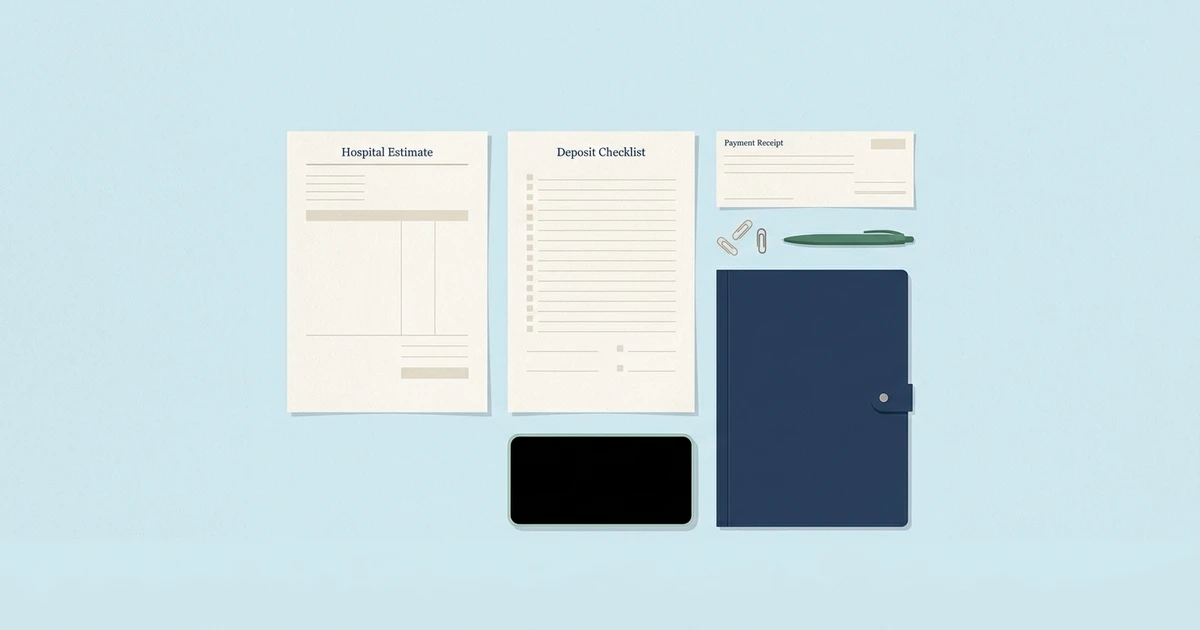
Do not pay against a vague message that only says the procedure name and total. A useful hospital estimate should show the patient scenario used for planning, the proposed procedure or pathway, the exact hospital branch, room or stay assumptions, inclusions, exclusions, variable items, deposit terms, and validity period.
Ask for the estimate to answer:
- What diagnosis, stage, procedure, or pathway was assumed?
- Which hospital branch and department issued it?
- Which doctor or team reviewed the available records?
- Which room category and hospital stay are assumed?
- Which tests, medicines, devices, implants, blood products, ICU care, rehabilitation, and follow-up are included?
- Which items are excluded or still unknown?
- What can change after examination, updated testing, pathology review, anesthesia review, or complications?
- How long is the estimate valid?
The CDC medical tourism chapter, accessed 19 August 2026, says medical travel should include planning for financing, follow-up care, medical records, rights, and legal recourse. That is why a deposit question is not only a payment question. It is also a continuity and documentation question.
Ask refund and cancellation questions in writing
Deposit rules differ by hospital, package, treatment type, booking stage, and cancellation reason. Do not infer the rule from another patient’s experience or from a competitor package page. Ask for written terms that apply to your quote.
Use these questions:
- Is the deposit refundable if the patient decides not to travel?
- Is it refundable if the hospital changes the proposed plan after reviewing new reports?
- Is it refundable if visa approval is delayed or refused?
- Is it refundable if the treating clinician advises a different treatment?
- Is it transferable to another date, doctor, or hospital branch?
- Are bank charges, card charges, or currency conversion losses deducted?
- What is the cancellation deadline?
- How long does a refund usually take once approved?
- Who approves the refund, and which email or portal confirms it?
These questions do not guarantee a refund. They make the terms visible before the patient commits.
Verify payment instructions independently
Payment fraud risk rises when a patient is under pressure, dealing across time zones, or receiving instructions through forwarded screenshots. The Federal Trade Commission, accessed 19 August 2026, warns that money sent by wire can be difficult to recover and that pressure to pay immediately is a warning sign.

Before paying:
- Confirm the recipient name through an official hospital channel.
- Confirm account details using a phone number, email address, or portal already listed by the hospital.
- Be cautious if the recipient name does not match the hospital or documented service provider.
- Do not rely only on a screenshot, chat message, or forwarded bank slip.
- Ask whether a card, bank transfer, official payment link, or hospital portal is available.
- Keep the payment request, estimate, receipt, and confirmation together.
This does not mean every transfer is unsafe. It means the payment route should be verified before money leaves the account.
Keep receipts, bills, and version history
India’s Clinical Establishments FAQ says the Act supports public registration, transparency, displayed charges, and record maintenance, while also noting that adoption varies by state and union territory (Clinical Establishments Division, accessed 19 August 2026). Patient-rights material also describes rights around records, reports, rate transparency, itemized bills, and grievance routes (Jago Grahak Jago, accessed 19 August 2026).
For a medical traveller, the practical step is to preserve a clean file:
- The estimate version used before payment
- Written deposit terms
- Payment instructions
- Proof of payment
- Receipt or acknowledgement
- Any revised estimate
- Admission or appointment confirmation
- Final itemized bill after care
- Discharge summary and clinical records
Do not store real patient records in ordinary chat or shared folders. Use only an approved secure route when a coordinator or hospital asks for medical documents.
Know what can still change after deposit
A deposit may support scheduling or administrative preparation, but the medical pathway can still change. The treating team may need an in-person examination, updated imaging, pathology review, anesthesia assessment, additional tests, or a different procedure discussion.
Ask the hospital what happens if:
- The diagnosis or stage changes after review.
- The procedure is postponed.
- The patient needs optimization before admission.
- ICU or longer stay becomes necessary.
- A device, implant, medicine, or blood-product assumption changes.
- The patient cannot travel on the planned date.
- An attendant’s travel plan changes.
The answer should come from the correct owner. The clinician explains clinical changes. The finance team explains billing changes. The visa authority decides visa approval. The airline or treating clinician handles travel-clearance requirements.
What Virello Health can help clarify
Virello Health can help organize the estimate questions, coordinate with the hospital, and keep the clinical and non-clinical pieces in one planning file. It can also help the patient prepare records through the approved intake route and ask the hospital for written clarification.
Virello cannot decide clinical suitability, issue a visa, guarantee a hospital date, promise a final bill, reverse a bank transfer, or enforce a refund. Those decisions sit with the hospital, licensed clinicians, government authorities, banks, insurers, and other providers.
When your estimate is ready, you can upload reports for case coordination or contact the Virello team with the current question. Do not send medical records into public chat.
Final checklist before paying
Before paying a hospital deposit, pause until each line has an answer.
| Check | Answer to record |
|---|---|
| Current estimate version | Date, hospital branch, and currency |
| Clinical assumption | Diagnosis, procedure, room, stay, and planned pathway |
| Included items | Hospital, professional, tests, medicines, devices, ICU, rehab, follow-up |
| Excluded items | Travel, accommodation, caregiver, complications, extra tests, extended stay |
| Deposit purpose | Booking, admission, package reservation, or other stated purpose |
| Refund terms | Refundable, partly refundable, non-refundable, transfer rules |
| Payment route | Verified recipient, method, fees, and currency |
| Receipt | Format, issuer, and when it will be sent |
| Change process | Who revises the estimate if the plan changes |
| Role boundary | Clinician, hospital, coordinator, bank, insurer, and visa owner |
If any answer is missing, ask for clarification in writing before treating the payment request as ready.
Sources
- CDC Yellow Book: Medical Tourism, accessed 19 August 2026.
- FTC: What To Know Before You Wire Money, accessed 19 August 2026.
- Clinical Establishments Division: FAQ, accessed 19 August 2026.
- Jago Grahak Jago: Patient Rights, accessed 19 August 2026.
- Virello Health: Treatment Quote for Medical Care in India, accessed 19 August 2026.