
Choose by proof, not by a best-company claim
The safest way to choose a medical tourism company in India is to compare evidence: who is coordinating, which hospital and clinician are involved, what is written before payment, how reports are handled, what visa support does and does not include, and how follow-up is planned.
Avoid treating “best company” lists as the decision. Medical tourism means travelling internationally for medical care, and the CDC advises people considering care abroad to discuss plans with healthcare professionals and understand risks, complications, records, insurance, and follow-up before committing (CDC medical tourism guidance, accessed 2026-09-24).
A facilitator can make coordination easier. It should not replace the hospital, the licensed clinician, the visa authority, the insurer, or local emergency care.
Use this 10-point company scorecard
Score each company by what it can show in writing, not by how confident the marketing sounds.
| What to compare | Good sign | Slow down if |
|---|---|---|
| Coordinator identity | Named coordinator and clear contact route | Only personal numbers or changing names |
| Company role | Written scope of services | Vague promise to handle everything |
| Hospital identity | Exact hospital branch and department | Hospital named only after payment |
| Clinician details | Doctor or team can be verified through official routes | Credentials are claimed but not traceable |
| Records process | Secure report pathway and clear file guidance | Sensitive reports requested casually in ordinary chat |
| Estimate quality | Written assumptions, inclusions, exclusions, validity, and change triggers | One-line package price |
| Payment clarity | Named payment owner, receipt process, refund or cancellation terms | Urgent personal-account transfer |
| Visa support | Official source links and process support | Guaranteed or express visa promise |
| Follow-up plan | Discharge records and return-home communication are discussed early | Care appears to end at surgery or discharge |
| Limits | The company states what it cannot decide | It promises outcome, travel fitness, price, or clinical suitability |
This scorecard does not certify a company as safe. It helps you decide what to verify before sharing records, paying a deposit, or booking travel.
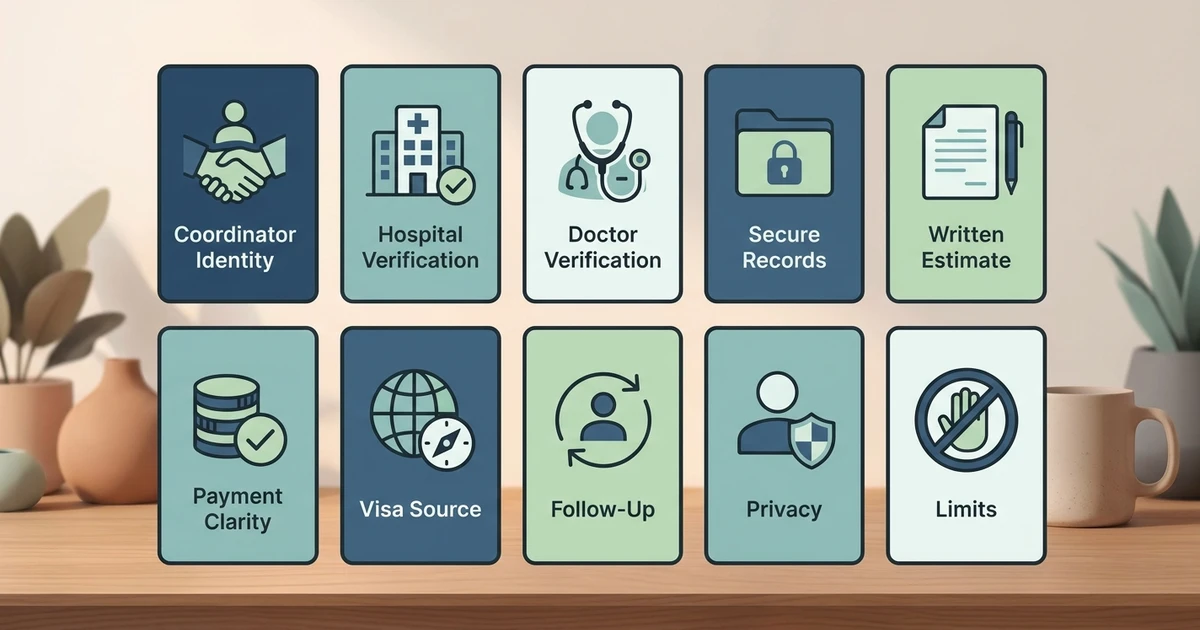
For warning signs that suggest a pause-and-verify step, use the medical tourism scams in India guide. This article is broader: it helps you compare companies before you choose one.
Check who is accountable for coordination
A medical tourism company should explain its role in plain language. Ask who receives your first message, who reviews the records for completeness, who requests hospital input, who explains written estimates, who coordinates logistics, and who responds if plans change.
The Medical Tourism Magazine facilitator checklist recommends looking for company registration, clearly identified management or staff, provider evaluation process, privacy practices, and contract scope (Medical Tourism Magazine facilitator guide, accessed 2026-09-24). That is industry guidance, not an India regulator, so treat it as a practical question set rather than proof of quality.
Ask for written answers to these questions:
- What services are included before travel, during treatment, and after discharge?
- Which services are arranged but billed separately?
- Who issues the hospital estimate?
- Who collects any deposit or payment?
- What happens if the hospital changes the plan after examination?
- Who handles translation, airport pickup, accommodation, attendant support, and follow-up scheduling?
- What will the company not do?
The last question matters. A credible coordinator should be clear that licensed clinicians make care decisions and that official authorities decide visa and entry outcomes.
Verify hospitals and doctors through official routes
Do not rely only on a company website, brochure, or chat screenshot for hospital and doctor claims. Ask for the exact hospital branch, department, doctor name or specialty team, and the route you can use to confirm the appointment or estimate.
The CDC notes that medical tourism websites may not make comprehensive facility accreditation, certification, or clinician qualification details available, and that accreditation does not guarantee an outcome (CDC medical tourism guidance, accessed 2026-09-24).
For Indian hospital accreditation checks, use the NABH accredited healthcare organisation directory where relevant. Check the exact facility, programme, scope, and validity. A group brand or city name is not enough.
For doctors, the National Medical Commission Indian Medical Register publishes registered doctors with State Medical Councils and notes that the data is being updated, so live verification through NMC or state medical council routes may still be needed before relying on a credential.
These checks are not guarantees. They are basic filters before you commit.
Make report-led planning the first serious step
A company that gives a confident package or treatment plan before understanding your records is asking you to trust too much.
Virello Health’s upload reports page explains that organized reports, scan images, and medical summaries affect second opinions, quotes, shortlists, and travel-readiness discussions. Its second opinion page also makes the boundary clear: a remote opinion can help review direction and questions, but it does not replace in-person assessment or emergency care.
Before you ask for a quote, prepare:
- Current diagnosis or suspected diagnosis.
- Recent consultation notes.
- Lab results.
- Imaging reports and image files when available.
- Biopsy, pathology, operative, or discharge summaries when relevant.
- Current medication list.
- Proposed treatment from your current doctor, if any.
- Key questions you want answered.
Do not include passports, full financial details, or unnecessary personal identifiers unless a secure, approved process asks for them.
Require written estimate clarity before payment
The company should help you understand what a written estimate says and what it does not say. It should not pressure you to compare only the headline total.
Virello’s treatment quote guidance says a reliable estimate should be based on records and should explain the likely procedure, hospital stay, inclusions, exclusions, and factors that can change the final bill.
Ask whether the estimate states:
- Which records were reviewed.
- Which hospital branch and doctor team are assumed.
- Which procedure or treatment pathway is assumed.
- Room category and expected hospital stay.
- Tests, medicines, devices, implants, ICU, rehabilitation, and follow-up assumptions.
- What is excluded.
- What can change after arrival or examination.
- Payment destination, deposit terms, refund or cancellation rules, and receipt process.
Use the hospital deposit questions guide before sending money. Use the treatment quote exclusions guide if the estimate looks thin or uses broad package language.
Treat visa support as process support
A medical tourism company can help you understand documents, hospital letters, timing questions, and process steps. It cannot guarantee approval, entry, processing time, or category.
The official India Visa Online portal says foreign nationals entering India generally need a valid passport and visa or eVisa unless exempt. It also states that the Government of India does not authorise agents or intermediaries to charge fees for emergency, express visa, eVisa, or eArrival-card facilitation, and that eArrival information is not a visa.
Before paying for visa-related help, ask:
- Which official source is being used?
- What is included in the service fee, if any?
- What fees go directly to official channels?
- Who prepares hospital letters or supporting documents?
- What happens if the authority requests more information?
- What is not guaranteed?
Recheck the official portal close to application time because visa and entry rules can change.
Ask about follow-up before you travel
Follow-up is part of company selection, not an afterthought. The company should explain how discharge documents, pending reports, prescriptions, follow-up appointments, and home-clinician communication will be handled.
The CDC advises medical tourists to understand whether follow-up care is included and scheduled, to obtain records in English, and to provide them to healthcare professionals seen later (CDC medical tourism guidance, accessed 2026-09-24).
Ask the company:
- Which discharge documents will be collected?
- How will imaging and lab files be shared?
- Who schedules follow-up with the Indian team?
- What happens if pathology or other results return after discharge?
- Can the company help communicate with a home clinician if consent and hospital workflow allow?
- Which follow-up costs are separate?
- When should the patient seek local urgent care instead of waiting for an overseas reply?
Virello’s post-discharge follow-up support can help organize records, delayed results, follow-up scheduling, and communication routes. It cannot replace clinical examination, emergency care, or the treating team’s instructions.
Where Virello fits in the comparison
Virello Health is one option to evaluate with the same scorecard. The useful question is not “Is Virello the best?” The useful question is whether Virello’s workflow fits what you need and whether the next step is clear.
Virello can help with:
- Organizing report-led next steps.
- Routing secure report upload.
- Coordinating second-opinion questions.
- Requesting and clarifying written treatment estimates.
- Separating hospital costs from non-clinical logistics.
- Planning visa-process support, pickup, accommodation, interpreter, attendant, and follow-up questions.
Virello cannot diagnose, prescribe, choose treatment for you, guarantee a hospital result, guarantee a visa, promise a final price, or decide whether you are fit to travel.
After you use the scorecard, you can contact Virello Health or use the secure report pathway if you want help organizing the next step.
Questions to ask before choosing
Use these questions before you commit to any company:
- Which exact hospital branch and specialty team would review my case?
- How are doctors and facilities verified?
- Which records should I share first?
- Is there a secure report upload route?
- What will I receive before paying a deposit?
- Who issues the estimate?
- What is included, excluded, conditional, or billed separately?
- Who explains clinical changes?
- Who explains billing changes?
- Which visa steps are official, and which are only support?
- What follow-up help is available after discharge?
- What are the company’s limits?
If the answers are vague, ask again in writing. If the answers stay vague, slow down.
Sources
- CDC Yellow Book: Medical Tourism, accessed 2026-09-24.
- NABH: Find an Accredited Healthcare Organisation, accessed 2026-09-24.
- National Medical Commission: Indian Medical Register, accessed 2026-09-24.
- India Visa Online, accessed 2026-09-24.
- Medical Tourism Magazine: Choosing a Medical Tourism Facilitator, accessed 2026-09-24.
- Virello Health: Contact, accessed 2026-09-24.
- Virello Health: Upload Medical Reports, accessed 2026-09-24.
- Virello Health: Treatment Quote, accessed 2026-09-24.